Have Google AI Mode ads launched in Turkey?
No. Google is expanding ads in AI Mode to 10 additional countries, and Turkey is not among them. Still, the move shows that Google is taking search into a conversational format and bringing advertising along with it. For Turkish e-commerce brands, the real question is this: does this direction affect Q4 campaign plans today? The short answer: you don't need to change your ad budget. But now is the right time to prepare your feed, product pages and ad copy for longer queries.
Which countries is it available in?
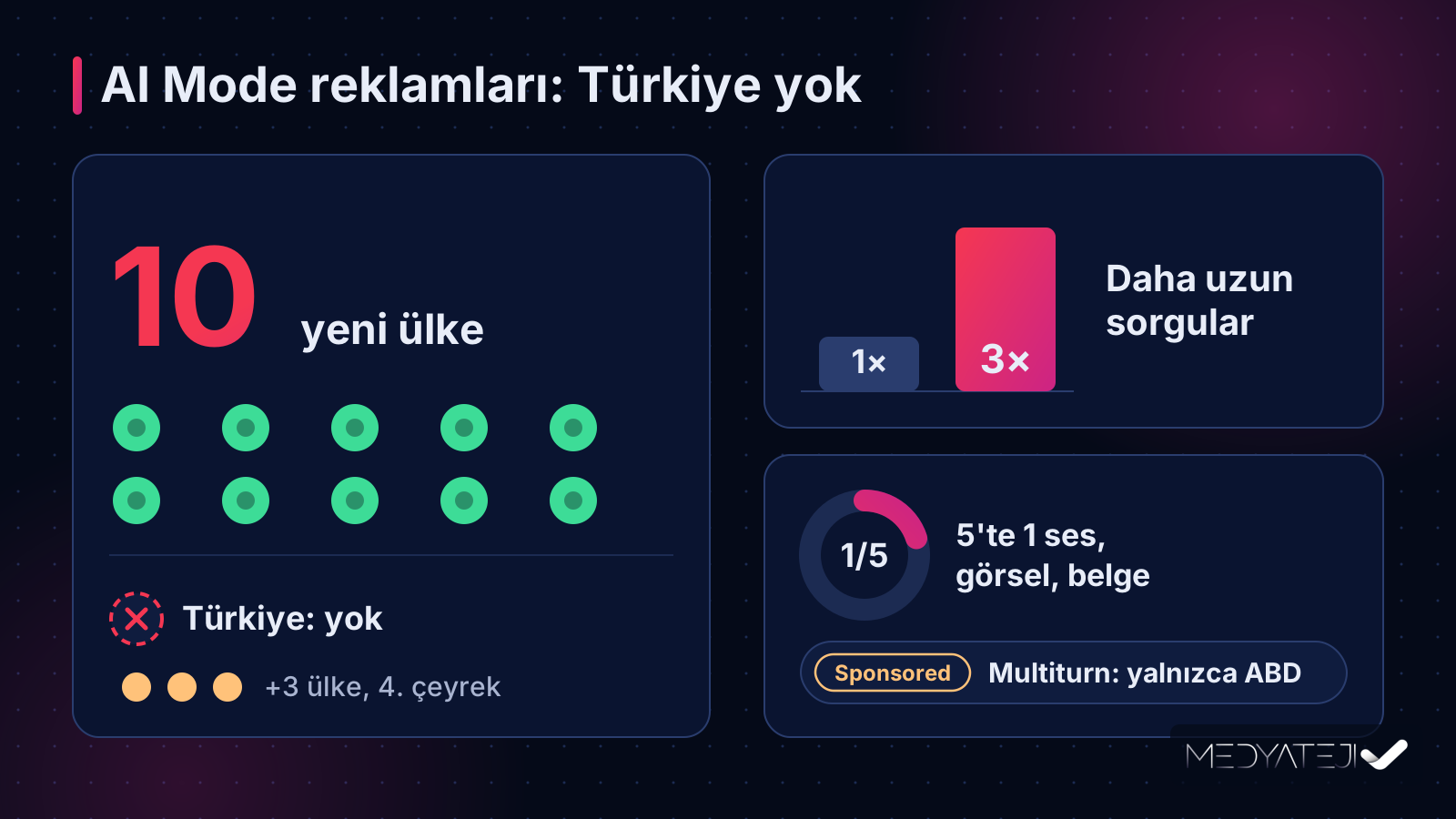
The new countries are Australia, Canada, India, Kenya, Malaysia, New Zealand, Nigeria, Pakistan, the Philippines and Singapore. Google also plans to add Brazil, Mexico and the United Kingdom in Q4 2026.
A few details worth knowing:
- Google's help page lists English as the language, and in Pakistan only text ads are available.
- Google says its list of countries and languages may not be exhaustive.
- The announcement gives no date or commitment for Turkey, so it would be wrong to say "it's coming soon."
What do multiturn ads mean?
Google announced that it has launched multiturn ads in the US so it can show ads on follow-up questions in AI Mode. A Google spokesperson explained it this way: multiturn ads appear in the responses to follow-up questions while the user is having a back-and-forth conversation with AI Mode. The ads will be labeled "Sponsored."
There is a small discrepancy between sources on dates. Search industry news reports that the announcement was made on October 28. Common Thread Collective, on the other hand, reports that a broader rollout of multiturn ads in the US was announced on October 30. In this article, we treat October 28 as the official announcement date.
There is an important limit: the multiturn ads launch is restricted to the US. Google has not given a date for anywhere outside the US.
Which campaign types can appear in AI Mode?
There is no separate "AI Mode campaign." Google Ads has no standalone AI Mode campaign type, and turning on AI Max does not let you select AI Mode placements. Ads are served through existing eligible campaigns. The eligible types are:
- Performance Max: Google's May 2025 announcement described Performance Max, Shopping and broad match Search campaigns (including AI Max for Search) as eligible for AI Mode tests.
- Shopping: Product ads and the feed-based structure are on this list.
- Broad match Search and AI Max: At Google Marketing Live 2026, Google recommended AI Max for Search, AI Max for Shopping and Performance Max for access to new AI formats.
- Exact and phrase match: In a small experiment in September, text ads were reportedly shown in AI Mode with these match types as well, when the intent was clear and direct.
Advertisers in the new countries don't get a choice either. For advertisers in these 10 countries, the change requires no action and offers no way to opt out. Measurement is also limited: your ability to separate out and measure ad performance within AI Mode is still restricted.
How is search behavior changing?
According to Google's Q3 call, AI Mode queries are on average three times longer than traditional searches, and globally one in five AI Mode searches uses voice, images or documents. Google disclosed these figures and there is no independent verification. Still, they show the direction: instead of "shoes," users write or say at length what they're looking for, what it's for, what their budget is and which features they want.
How should you prepare your product feed, product pages and ad copy?
The following are our recommendations. Google has not published them as an official AI Mode checklist. However, according to WordStream's assessment, in addition to the keyword, the ad content and landing page also need to be relevant to the answers AI Mode gives.
Product feed
- Add the brand, model and distinguishing features (material, size, intended use) to titles.
- Write descriptions with concrete information rather than marketing slogans.
- Keep GTIN, stock, price and shipping information complete and up to date.
- Increase the number of images. The share of visual and voice search is growing.
Product page
- State clearly at the top of the page what the product does and who it's for.
- Answer frequently asked questions (compatibility, care, returns, delivery time) on the page.
- Add a short comparison section showing how it differs from similar products.
- Keep reviews and ratings visible.
Ad copy
- Write specific copy that answers the question: "Water-resistant for kids, 6 size options."
- Prepare separate variations for different intents (gift, comparison, first purchase) for the same product.
- Use these variations in Performance Max and AI Max asset groups.
This preparation isn't just for AI Mode. It also helps standard Shopping and Performance Max performance.
What does Google's "AI Mode earns less" statement say?
We need to be balanced here. On Alphabet's earnings call, Philipp Schindler said that despite strong growth in AI Mode queries, the lower monetization seen in AI Mode had an impact. The details:
- Schindler cited lower AI Mode monetization as one of three reasons for slower growth. He listed foreign exchange first, then retail and media effects.
- He did not say what it is lower compared to, or how large the financial impact is.
- Google's defense: Schindler said most AI Mode queries are top-of-funnel queries, and that these make it possible to capture new, high-value commercial intent.
- He also gave a data point on product ads: within AI Mode, the click-through rates of sponsored and organic product listings are already similar.
What this means for advertisers: AI Mode is not yet a mature channel that can be measured separately. Don't base major decisions on it; base them on your existing campaign results.
What should Turkish brands do in Q4?
- Don't shift budget toward AI Mode. This placement isn't available in Turkey. Keep your proven campaigns for Black Friday and year-end.
- Improve feed quality. This pays off today too.
- Organize product pages in a question-and-answer format. Both search engines and AI assistants can use clear information more easily.
- Review your campaign structure. AI-powered structures such as Performance Max, Shopping and broad match are the types these channels use most.
- Follow the news. The addition of Brazil, Mexico and the United Kingdom will give a hint about how fast Google is rolling this out.
What does Medyateji recommend?
You don't need to set up a separate campaign for AI Mode ads. What you need is to keep your feed, campaign structure and product pages solid together. Our Google Ads management service starts at 15,000 TL. The scope, timeline and fee are set upfront, with no contracts and no surprise fees.
For the content and technical structure of your product pages, take a look at our SEO service, and if your site's structure needs changes, our Web Site / Software service.
Frequently asked questions
Are Google AI Mode ads available in Turkey?
Turkey is not included in Google's October 28, 2026 announcement. Ads launched in 10 new countries, and Google set a Q4 2026 target for Brazil, Mexico and the United Kingdom. Google also notes that the list may not be exhaustive.
Can I create a separate Google Ads campaign for AI Mode?
No. There is no separate AI Mode campaign, and turning on AI Max does not let you select AI Mode placements. Ads are served through eligible existing campaigns.
What should I do today to prepare for AI Mode ads?
Enrich your product feed, add clear information and frequently asked questions to your product pages, and write ad copy that is conversational and specific. This preparation also benefits Performance Max, Shopping and broad match Search campaigns.